
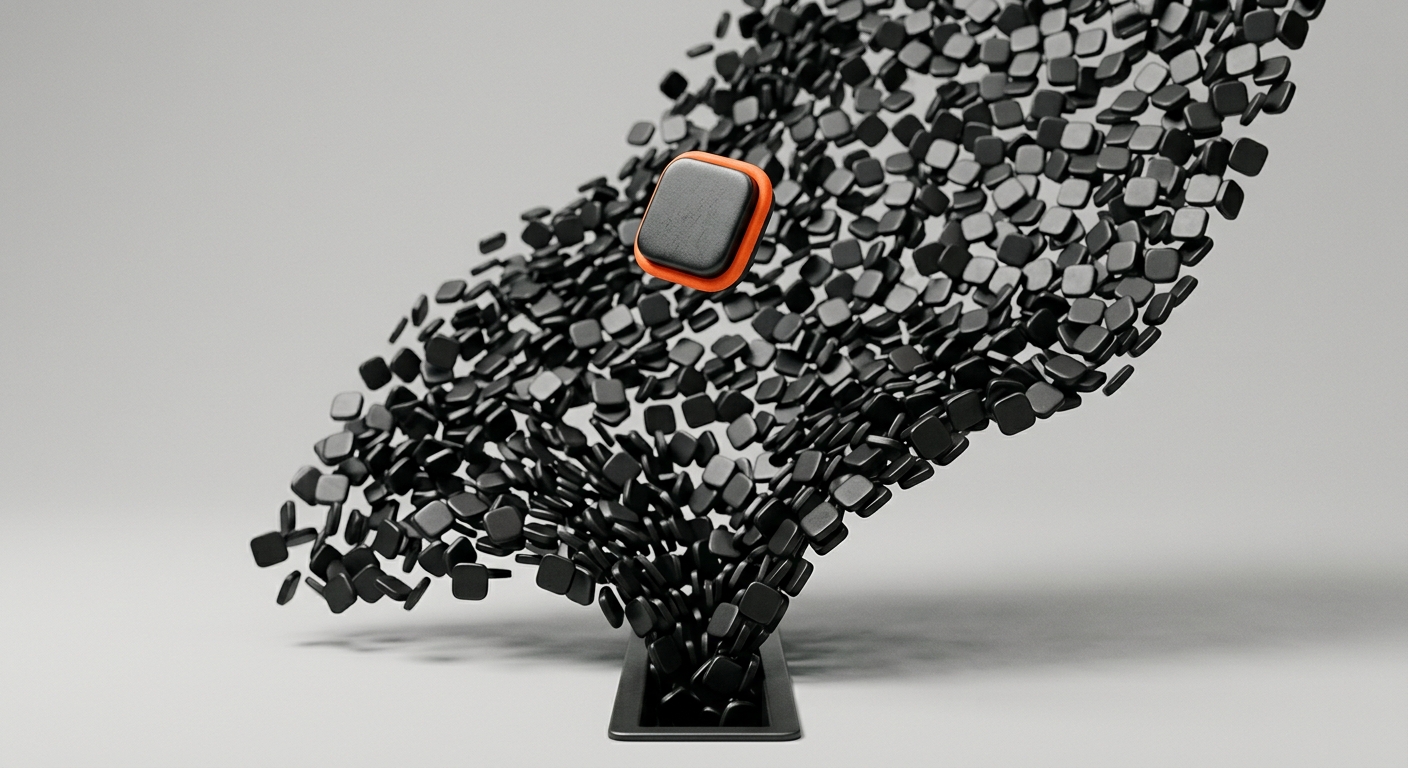
Somewhere in your company right now, a colleague is typing a question into Microsoft Teams that has already been answered three times. Not because they are lazy, but because the answer is buried in a thread from four months ago, in a channel they are not in, or in a private message between two people, one of whom has since left. The answer exists. It is just unreachable.
This is the quiet tax that almost no company measures. Every solved problem gets re-solved. Every hard-won decision gets re-litigated. The average worker now receives 153 Teams messages a weekday and is interrupted every two minutes during core hours2. Inside that torrent, your company’s best thinking is produced and then immediately lost. Chat feels like communication. For knowledge, it is a graveyard.
This article is for the CTO, operations lead, or Geschaeftsfuehrer who senses their team keeps paying for the same knowledge twice. It explains why chat destroys knowledge, what it costs, why the usual fixes fail, and how a Company Brain plus AI employees connected to Teams and Slack turn conversations into durable memory that survives turnover.
TL;DR
Chat is not memory - Teams and Slack are built for presence and speed, so answers scroll out of reach within hours and become effectively unretrievable.
The cost is huge and hidden - workers lose about 1.8 hours a day searching for information and another 6 hours a week reinventing work that already exists1,3.
Search and wikis do not fix it - search returns keyword fragments with no sense of what is final; wikis go stale the moment someone forgets to update them.
A Company Brain does - it captures the answer and the reasoning from where work happens, keeps it current, and makes it reusable by people and AI employees.
Turnover stops being catastrophic - 42 percent of company knowledge is unique to the individual3; capturing it continuously means a resignation no longer opens a hole.
The Chat Graveyard
Chat tools won the workplace. Microsoft Teams passed 320 million daily active users, and messaging is now the default way work gets coordinated, questioned, and decided2. The problem is not that people talk in chat. The problem is that the most valuable output of that talk, the answers and decisions, has nowhere durable to go.
- Answers are born and buried in the same place - a specialist writes a precise, correct explanation into a thread, three people react with a thumbs-up, and within a day it is 200 messages deep and gone.
- The volume guarantees loss - at 153 Teams messages a weekday plus email and Slack on top, no human can retain, tag, or file what matters2.
- Private DMs are a black hole - a large share of real decisions happen in one-to-one messages that no colleague can ever search, even with full permissions.
- History has a hard expiry - Slack’s free plan keeps only 90 days of message history, so older answers do not just become hard to find, they physically disappear5.
- Context evaporates fast - a message like “use the new template, not the old one” is meaningless six months later when nobody remembers which template or why.
- Nobody owns the memory - the tool assumes someone, somewhere, will copy the important parts into a document. Almost nobody ever does.
Key Data Point
Nearly half of employees (48 percent) and more than half of leaders (52 percent) say their work already feels chaotic and fragmented2. That fragmentation is exactly the condition under which knowledge cannot settle anywhere durable.
Contrast two ways the same answer can end up. In a chat graveyard it lives for a day, then decays. In a Company Brain it lives for as long as it is useful and gets retrieved on demand.
| Property | Answer in a Chat Thread | Answer in a Company Brain |
|---|---|---|
| Lifespan | Hours to days before it scrolls away | As long as it stays relevant |
| Findability | Keyword search across noise, if at all | Retrieved by meaning, on demand |
| Context | Stripped away as the thread moves on | Kept with the decision and reasoning |
| Reach | Only people in that channel or DM | Everyone with permission, plus AI employees |
| Survives turnover | No, it leaves with the person | Yes, captured while they are here |
| Reusable by AI | No structured memory to draw on | Yes, an AI employee answers from it |
The graveyard is not a tooling accident. It is the predictable result of using a real-time medium as a permanent record. To fix it, you have to understand why chat is structurally hostile to memory.
Why Chat Is Where Knowledge Goes to Die
Email and Slack have been called the place where knowledge goes to die, and the description fits13. It is not because the tools are badly built. It is because their core design goals are the opposite of what memory needs.
The design of chat fights against memory
- Optimised for now, not later - chat rewards immediacy and presence. The interface pushes the newest message up and everything else down and out of sight.
- No structure by default - a document has a title, sections, and an owner. A decision made across 15 messages has none of those, so nothing signals “this is the answer”.
- Fragmented across channels and DMs - the same topic is discussed in a project channel, a leadership DM, and a side thread, with no single source of truth.
- Final and discarded look identical - a rejected idea and the approved decision sit in the same font, minutes apart. Search cannot tell them apart, and neither can a newcomer.
- Silos by permission - knowledge in a channel you are not in, or a DM you are not part of, is invisible to you no matter how relevant it is.
- History is capped or costly - retention limits mean older knowledge is deleted or locked behind an upgrade, and even where it is kept, it is not organised5.
- It becomes dark data - Gartner calls information that organisations store but never use again “dark data”, and chat history is one of the largest dark-data stores in any company7.
The Scale of the Problem
An estimated 55 percent of enterprise data is dark, stored but never used again, and nearly one in three organisations report that 75 percent or more of their stored data is dark or obsolete8. Years of chat history sit squarely inside that dark pile.
Tacit knowledge makes it worse
The knowledge most worth keeping is the hardest to write down. Roughly 90 percent of organisational knowledge is tacit, held in people rather than documents, and it walks out the door every time someone leaves10. Chat is where a lot of that tacit knowledge briefly surfaces, in an offhand explanation or a “here is how we actually handle this” message, before disappearing again.
“If only HP knew what HP knows, we would be three times more productive.”
- Lew Platt, former CEO of Hewlett-Packard12
Platt said that decades before Teams existed, but the sentence has only become truer. Your company knows an enormous amount. Most of it is scattered across chat threads no one will ever read again.
What the Chat Graveyard Actually Costs
Lost knowledge does not show up as a line item, which is exactly why it goes unfixed. But the research on wasted search time, duplicated work, and turnover puts a hard number on the leak.
- Search time - knowledge workers spend about 1.8 hours a day, 9.3 hours a week, just searching for and gathering information1. IDC-based estimates run even higher, near 2.5 hours a day on retrieval6.
- Reinventing the wheel - employees lose roughly 6 hours a week duplicating work that already exists, and almost one in three lose more than 6 hours3.
- Why the duplication happens - for more than 70 percent of employees, they redo work because they cannot reach the person who did it, or they never knew that person existed3.
- The onboarding hole - the average new hire spends around 200 hours chasing down lost information or recreating processes that were never captured3.
- Enterprise-scale losses - inefficient knowledge-sharing costs large US businesses an estimated $47 million per year4.
- The turnover multiplier - voluntary turnover among knowledge workers is expensive, and knowledge loss is the largest hidden component, not the recruiting fee9.
| Cost Driver | Impact | Source |
|---|---|---|
| Searching for information | 1.8 hours/day per worker (~20% of the week) | McKinsey1 |
| Reinventing existing work | ~6 hours/week per employee | Panopto3 |
| Knowledge unique to one person | 42% of all company knowledge | Panopto3 |
| New-hire ramp waste | ~200 hours chasing lost information | Panopto3 |
| Knowledge-sharing inefficiency | ~$47M/year at large US firms | HR Dive4 |
| Tacit knowledge at risk | ~90% of knowledge lives in people | 360Learning10 |
Do the Math on Your Own Team
Take a 50-person team. If each person loses just 6 hours a week to searching and duplication, that is 300 hours a week, or the equivalent of roughly 7 full-time employees spent entirely on finding things that already exist. Most of that is knowledge that was created once, in a conversation, and then lost.
These are not abstractions. Every one of these hours is a specific answer that was given, forgotten, and paid for again. It helps to look at exactly how a single answer dies.
The Anatomy of a Lost Answer
To see the leak clearly, follow one good answer through its short life. The pattern repeats thousands of times a year in a mid-sized company, across every department.
- The question - a junior asks in a channel: “Which discount tier applies when a customer orders across two business units?”
- The expert answers - the head of sales ops writes three precise sentences explaining the rule and the one exception. Correct, complete, valuable.
- The moment of use - the junior applies it, the deal closes, everyone moves on. The answer did its job.
- The burial - within a day the thread is far up the channel. Within a week it is unfindable without knowing the exact words used.
- The re-ask - two months later a different colleague hits the same situation and asks the same question, in a different channel.
- The expert answers again - the head of sales ops re-explains, slightly differently this time, introducing a small inconsistency.
- The departure - a year later the head of sales ops leaves. The rule now lives nowhere. The next person guesses.
Now multiply that across the real situations where it happens:
- Manufacturing - a technician explains in a shift channel exactly how to reset a finicky machine after a specific fault. Next shift, same fault, nobody remembers the trick, the line stops.
- Customer service - an agent works out the correct response to a rare warranty edge case and posts it in a DM. Six months later the customer’s twin case is handled wrong.
- Finance - the controller explains in Teams how to book an unusual intercompany transaction. At year-end close, with the controller on holiday, the team re-invents it and gets it wrong.
- IT and operations - an engineer posts the fix for a recurring integration error. It scrolls away, so the next outage takes three hours instead of ten minutes to resolve.
- Sales - a rep shares the winning objection-handling line for a specific competitor in a private message. It never reaches the rest of the team.
- HR - the exact steps for a special-case parental-leave calculation are explained once in chat, then lost, so the next case is escalated all over again.
- Legal and compliance - the reasoning behind why a clause was accepted last time sits in a thread, so the same negotiation restarts from zero.
- Procurement - which supplier is approved for a niche part, and why the obvious cheaper one was rejected, is a chat message no one can find at reorder time.
- Product - the reason a feature was cut lives in a decision thread, so it gets proposed again a year later and re-debated for a week.
The Pattern
In every case the knowledge was created. Someone did the thinking. The failure is not intelligence or effort - it is that a real-time tool was used as the system of record, and real-time tools do not keep records.
Stop paying for the same answer twice
Book a 30-minute call. We will find the chat channels where your knowledge leaks fastest.

Why Search and Wikis Do Not Fix It
Most companies have already tried to solve this, and the fixes have well-known failure modes. Understanding why they fall short is the fastest way to see what actually works.
Native search: a better view of the graveyard
- Keyword, not meaning - search finds messages containing your words, so if the answer was phrased differently, you never see it.
- No sense of finality - it cannot tell you which of ten similar messages is the approved decision and which were rejected.
- Blind to private context - it cannot search DMs and channels you are not part of, where much of the real decision-making sits.
- No freshness signal - a two-year-old answer and last week’s revision look equally authoritative in the results.
Wikis and knowledge bases: right idea, wrong physics
- They rely on discipline - someone has to remember to write the answer down, in the right place, in their own time. Under 153 messages a day, they do not.
- They go stale silently - a wiki page is right the day it is written and slowly rots, with no signal that it is now wrong.
- They live apart from the work - people answer in chat because that is where the question is; the wiki is a separate trip nobody makes.
- They capture the what, not the why - even good pages record the decision but lose the reasoning that lets you adapt it to a new case.
| Approach | What It Does Well | Where It Fails |
|---|---|---|
| Native chat search | Finds exact-keyword messages fast | No meaning, finality, or private context |
| Wiki / knowledge base | Structured, deliberate pages | Depends on manual upkeep, goes stale |
| Enterprise search | Indexes many sources at once | Retrieves documents, does not remember |
| Personal AI accounts | Fast individual answers | Knowledge stays trapped with one person |
| Company Brain + AI employee | Captures answer and reasoning, stays current | Requires connecting to your tools first |
“Too many organizations fail to measure and manage information with the same discipline as other recognized assets, so they fail to generate sufficient value from them.”
- Doug Laney, data and analytics research fellow who coined the term dark data11
The gap is not more search or more pages. It is a system that treats knowledge as an asset to capture and maintain, not a byproduct to hope someone files. That is what a Company Brain is for.
From Chat Graveyard to Company Brain
A Company Brain is a durable, living memory of how your company works: its decisions, answers, processes, and the reasoning behind them. It is not another place to file things by hand. It captures knowledge from where work already happens and keeps it usable.
What makes it different from everything above
- It captures at the source - it draws knowledge from the tools your team already uses, including Teams and Slack, instead of asking people to duplicate it elsewhere.
- It keeps the reasoning - it stores not just the answer but why the decision was made, so the knowledge can be adapted, not just copied.
- It stays current - when a decision is superseded, the memory updates, so people retrieve the live answer, not a fossil.
- It is retrieved by meaning - a question gets the right answer even if it is phrased completely differently from the original.
- It serves people and AI - the same memory answers a colleague’s question and grounds an AI employee’s actions.
- It survives turnover - because the knowledge was captured while the expert was here, their departure does not erase it.
Chat as Memory vs a Company Brain
Chat as Your Memory
- ✗ Ephemeral - answers scroll away within hours
- ✗ Siloed - locked in channels and private DMs
- ✗ Un-searchable in practice - keyword match over noise
- ✗ Context-free - the reasoning is lost immediately
- ✗ Dies with people - leaves when the person leaves
A Company Brain
- ✓ Durable - answers persist as long as they are useful
- ✓ Unified - one memory across channels and tools
- ✓ Retrieved by meaning - the right answer, however you ask
- ✓ Keeps the why - reasoning captured with the decision
- ✓ Survives turnover - knowledge stays when people go
The Company Brain is the destination. The mechanism that fills it, without adding work for your team, is an AI employee connected to your chat tools.
How AI Employees Turn Conversations Into Memory
An AI employee is not a chatbot bolted onto a channel. It is a system that connects to your tools, understands the conversations it is given access to, and turns the answers inside them into durable memory it can then reuse.
The loop that stops the leak
- Connect - the AI employee is given scoped access to specific Teams and Slack channels where questions and decisions happen.
- Recognise - it identifies when a question has been meaningfully answered or a decision reached, not just when someone typed a message.
- Capture - it records the answer and its context in the Company Brain as structured, durable memory, with a link back to the original thread.
- Reuse - the next time a similar question appears anywhere, it answers directly from that memory instead of pinging an expert.
- Update - when a newer decision supersedes an old one, the memory is refreshed so the answer stays live.
What that looks like day to day
- The repeat question disappears - a colleague asks in Teams, the AI employee replies in-thread with the captured answer and a source link, in seconds.
- The expert stops being a help desk - the head of sales ops answers the discount-tier rule once; after that, the AI employee handles it.
- Onboarding compresses - a new hire asks the AI employee their questions instead of interrupting five colleagues, cutting into that 200-hour ramp3.
- Decisions keep their reasoning - when a product decision is made in a thread, the why is captured, so it is not re-debated next year.
- Cross-team answers surface - an answer given in one department’s channel becomes available to another, ending the “I did not know someone already solved this” duplication3.
- Work gets done, not just answered - because the AI employee also connects to your ERP, CRM, and email, it can act on the knowledge, not merely recite it.
The Shift
The conversation still happens in Teams and Slack, where your team likes it. What changes is that the conversation now leaves something behind. Every answered question makes the Company Brain smarter, and every future asker gets the answer instantly.
| Capability | Plain Chatbot | Enterprise Search | AI Employee + Company Brain |
|---|---|---|---|
| Answers in-thread | Sometimes | No | Yes, with source link |
| Captures new answers | No | No | Yes, into durable memory |
| Keeps reasoning | No | No | Yes |
| Stays current | No | Reindexes documents | Updates when decisions change |
| Acts on the knowledge | No | No | Yes, across connected systems |
| Survives turnover | No | Only what was documented | Yes, captured continuously |
A Practical Playbook to Stop the Knowledge Leak
You do not fix this by boiling the ocean. You fix it channel by channel, starting where the same questions repeat most. Here is a sequence that works.
Step by step
- Find the leakiest channels - identify the two or three channels where the same questions get asked over and over, usually internal support, operations, or a product channel.
- Name the repeat questions - list the ten questions your experts answer most often. This is your first target set and your baseline metric.
- Connect an AI employee - give it scoped access to those channels only, so the pilot is contained and easy to reason about.
- Seed the Company Brain - let it capture answers to the repeat questions first, so it delivers value in week one, not week ten.
- Answer once, then hand off - when a repeat question appears, the expert confirms the AI employee’s captured answer instead of writing a fresh one.
- Measure the drop - track how often the top ten questions still reach a human. A falling number is the proof the leak is closing.
- Expand by channel - once one channel is quieter, add the next. The Company Brain compounds as it covers more of the company.
- Fold in departures - before anyone leaves, point the AI employee at their key channels and DMs in scope, so their knowledge is captured while they are still here.
Knowledge-Leak Readiness Checklist
- You can name three channels where the same questions repeat weekly
- At least one expert is a constant human help desk for their team
- New hires take longer to become productive than you would like
- Important decisions are made in chat and not written anywhere else
- A recent departure left a visible hole in how something gets done
- People routinely ask in chat before they check any documentation
- Your Teams or Slack history is large but effectively unused
- You are willing to start with one or two channels, not everything
Fix It Now vs Keep Living With It
Capturing Knowledge Now
- ✓ Compounding memory - every answer captured makes the next one free
- ✓ Experts freed - your best people stop being a help desk
- ✓ Faster onboarding - new hires self-serve from real answers
- ✓ Turnover insured - knowledge captured before people leave
Leaving It in Chat
- ✗ Recurring tax - the same hours lost every single week
- ✗ Growing risk - each departure removes knowledge for good
- ✗ Inconsistent answers - the same rule drifts over time
- ✗ AI stays generic - no company memory to ground it
How Superkind Fits
Superkind builds custom AI employees for SMEs and enterprises, connected to the tools your team already uses. The approach is process-first: we start from how your people actually work in Teams, Slack, email, and your core systems, then capture and reuse the knowledge that flows through them.
- Connects to Teams and Slack - the AI employee reads the channels you scope it to and answers in-thread, where the question was asked.
- Builds a Company Brain - answers and decisions become durable, structured memory instead of scrolling away.
- Keeps the reasoning - it captures why a decision was made, not just the outcome, so the knowledge stays adaptable.
- Retrieves by meaning - colleagues get the right answer even when they phrase the question completely differently.
- Sits on your existing stack - it connects to SharePoint, CRM, ERP, and email too, so it can act on knowledge, not just recall it.
- Captures before departures - point it at a leaving expert’s in-scope channels so their know-how stays with the company.
- Stays current - when a decision changes, the memory updates, so nobody retrieves a stale answer.
- Enterprise-grade security - data stays in your infrastructure, moves over encrypted connections, and is scoped and audit-logged, which fits GDPR obligations.
- Live in weeks - the first AI employee goes into production in about two weeks, starting with your leakiest channels.
| Approach | Generic AI Assistant | Superkind |
|---|---|---|
| Knowledge source | The public internet | Your conversations and systems |
| Memory | None between sessions | A durable Company Brain |
| Where it works | A separate chat window | Inside Teams, Slack, and your tools |
| On turnover | Knows nothing about the person | Retains their captured knowledge |
| Action | Suggests text | Acts across connected systems |
| Time to value | Immediate but shallow | Weeks, and it compounds |
Superkind
Pros
- ✓ Captures at the source - inside the chat tools you already use
- ✓ Durable memory - a Company Brain, not a stateless bot
- ✓ Fast time-to-value - first AI employee live in about two weeks
- ✓ Acts, not just answers - connected to ERP, CRM, and email
- ✓ Data stays yours - your infrastructure, scoped and audit-logged
Cons
- ✗ Not a self-serve app - it is a build tailored to your workflows
- ✗ Needs channel access - it can only capture what it is scoped to
- ✗ Overkill for tiny teams - a 5-person team may not need it yet
- ✗ Requires clear ownership - someone has to steward what gets captured
Decision Framework: Is Your Knowledge Leaking?
Not every company needs to act on this today. This framework helps you judge how urgent your leak is and what to do about it.
| Signal | What It Means | Action |
|---|---|---|
| The same questions repeat weekly in chat | You are paying for the same answers again and again | Capture the top ten repeats first |
| One expert is everyone’s help desk | Your best person is a single point of failure | Hand their repeat answers to an AI employee |
| A recent departure left a hole | Knowledge is leaving with people | Capture in-scope knowledge before the next exit |
| Onboarding is slow and painful | New hires cannot self-serve from your memory | Give them an AI employee to ask instead of colleagues |
| Decisions live only in chat | Reasoning is being lost as fast as it is created | Start capturing decision threads and their why |
| You have fewer than 10 people | Everyone still knows everything | Revisit when the team or turnover grows |
A Simple Test
Pick one important answer your team relied on six months ago. Try to find it in Teams or Slack in under two minutes. If you cannot, that is your knowledge leak, and it is happening to thousands of other answers you have not thought to look for.
Related Articles
- Your Company’s Best Thinking Is Trapped in Personal ChatGPT Accounts - the sister problem: knowledge locked in individual AI chats instead of company memory.
- When Knowledge Is Power: Why Employees Hoard Know-How, and How a Company Brain Ends It - the human side of why knowledge does not get shared.
- Glean vs Company Brain: Enterprise Search Retrieves Documents, a Company Brain Remembers How You Work - why search is not the same as memory.
- The Copy-Paste Economy: How Much of Your Team’s Day Is Just Moving Data Between Systems - the related drain of manual data shuffling.
- Custom GPTs vs. Company Brain: Where Your Own GPTs Hit a Wall on Company Knowledge - why custom GPTs still do not know how your company works.
- The Shift Handover Problem: How Manufacturing Knowledge Vanishes Every Night - the same leak on the factory floor.
Frequently Asked Questions
It means the answers, decisions, and reasoning your team produces every day get typed into Microsoft Teams and Slack, scroll out of view within hours, and become effectively unretrievable. The information technically still exists somewhere in the message history, but nobody can find it, so the same questions get asked and re-answered again and again. The knowledge is not deleted - it is buried in an un-searchable stream that no one can mine.
Chat is designed for speed and presence, not memory. Messages are short, context-free, and split across hundreds of channels and private DMs. Search returns keyword matches with no way to tell a final decision from a discarded idea. Slack even caps message history at 90 days on its free plan, so older answers physically disappear. Documents at least have titles and structure; a decision made in a busy thread has neither.
McKinsey found knowledge workers spend about 1.8 hours every day, or 9.3 hours a week, just searching for and gathering information. Panopto research shows employees also lose around 6 hours a week reinventing work that already exists elsewhere. A large share of that loss traces back to answers that were given once in a chat thread and then became impossible to find again.
Not really. Native search finds messages that contain your exact keywords, but it cannot tell you which answer was final, whether it is still valid, or what the surrounding decision was. It also cannot search private DMs you are not part of, where a large amount of real decision-making happens. Search retrieves fragments; it does not reconstruct knowledge or keep it current.
A Company Brain is a durable, living memory of how your company actually works: its decisions, answers, processes, and the reasoning behind them. Unlike a wiki, it is not a set of static pages someone has to remember to update. It captures knowledge from where work already happens, including Teams and Slack, keeps it current, and makes it instantly reusable by both people and AI employees. It survives staff turnover because the knowledge no longer lives only in individual heads or private chats.
An AI employee connected to Teams and Slack can read the channels it is given access to, recognise when a question has been answered, and record that answer along with its context in the Company Brain. The next time anyone asks a similar question, in chat or anywhere else, the AI employee retrieves the durable answer instead of interrupting an expert. Over time the conversations that used to vanish become a growing, queryable memory.
Handled properly, it reduces risk rather than adding it. Knowledge that lives only in personal DMs and individual inboxes is the real governance problem, because it is invisible and uncontrolled. A Company Brain captures knowledge inside your own infrastructure with access controls and audit logs, processes data through encrypted connections, and can be scoped to specific channels. For German companies, this is easier to align with GDPR than a sprawl of ungoverned private chats.
Today, most of it leaves with them. Panopto found that 42 percent of company knowledge is unique to the individual employee, and roughly 90 percent of organisational knowledge is tacit, meaning it lives in people rather than documents. When someone resigns or retires, their answers in old chat threads become orphaned and unfindable. A Company Brain captures that knowledge continuously while the person is still there, so the departure does not create a hole.
Framing matters. The goal is not surveillance of individuals; it is capturing answers so people stop being interrupted with the same questions. Scope the AI employee to shared working channels, be transparent about what it does, and show the payoff quickly: fewer repeat pings, faster onboarding, and less time spent re-explaining things. When people see the interruptions drop, adoption follows.
Enterprise search retrieves documents and messages that already exist. It is a better index over the same graveyard. A Company Brain does something different: it captures the answer and the reasoning as durable, structured memory, keeps it current, and lets an AI employee act on it. Search hands you ten links and asks you to work out the answer. A Company Brain gives you the answer and remembers how your company reached it.
A focused deployment typically shows first results within a few weeks. You start by connecting an AI employee to one or two high-traffic channels where the same questions repeat, such as an internal support or operations channel. Within the first month you can measure the drop in repeat questions and the time experts get back. From there you expand channel by channel.
No. The point is not to replace the tools your team likes; it is to stop treating them as your memory. Teams and Slack stay exactly where they are for real-time conversation. The AI employee and the Company Brain sit on top, capturing the knowledge that flows through them so it becomes durable and reusable instead of scrolling away forever.
Sources
- McKinsey Global Institute - The Social Economy: Unlocking Value and Productivity Through Social Technologies
- Microsoft Work Trend Index 2025 - Breaking Down the Infinite Workday
- Panopto - How Much Time Is Lost to Knowledge-Sharing Inefficiencies at Work?
- HR Dive - Inefficient Knowledge-Sharing Costs Large US Businesses $47M a Year
- Slack - Knowledge Management in Slack (message retention and history)
- Cottrill Research - Survey Statistics: Workers Spend Too Much Time Searching for Information (IDC)
- Gartner IT Glossary - Dark Data
- Komprise - What Is Dark Data? Risks, Costs and Hidden Value for Enterprise AI
- Deloitte - Global Human Capital Trends
- 360Learning - Institutional Knowledge: Complete Guide
- KDnuggets - Exclusive Interview: Doug Laney on Big Data and Infonomics
- Lucidea - If Only HP Knew What HP Knows (Lew Platt)
- This and That - Information Silos: How Email and Slack Became Where Knowledge Goes to Die
- Speakwise - Slack Messaging Statistics 2026: Channel Noise, DM Volume, and Communication Sprawl
- Cyberhaven - Dark Data: What It Is and Why It Is a Security Risk
- Emerald Insight - If Only HP Knew What HP Knows: The Roots of Knowledge Management at Hewlett-Packard
Ready to turn your chat threads into lasting company memory?
Book a 30-minute call with Henri. We will find where your knowledge leaks fastest and outline how an AI employee captures it - no commitment, no sales pitch.
Book a Demo →