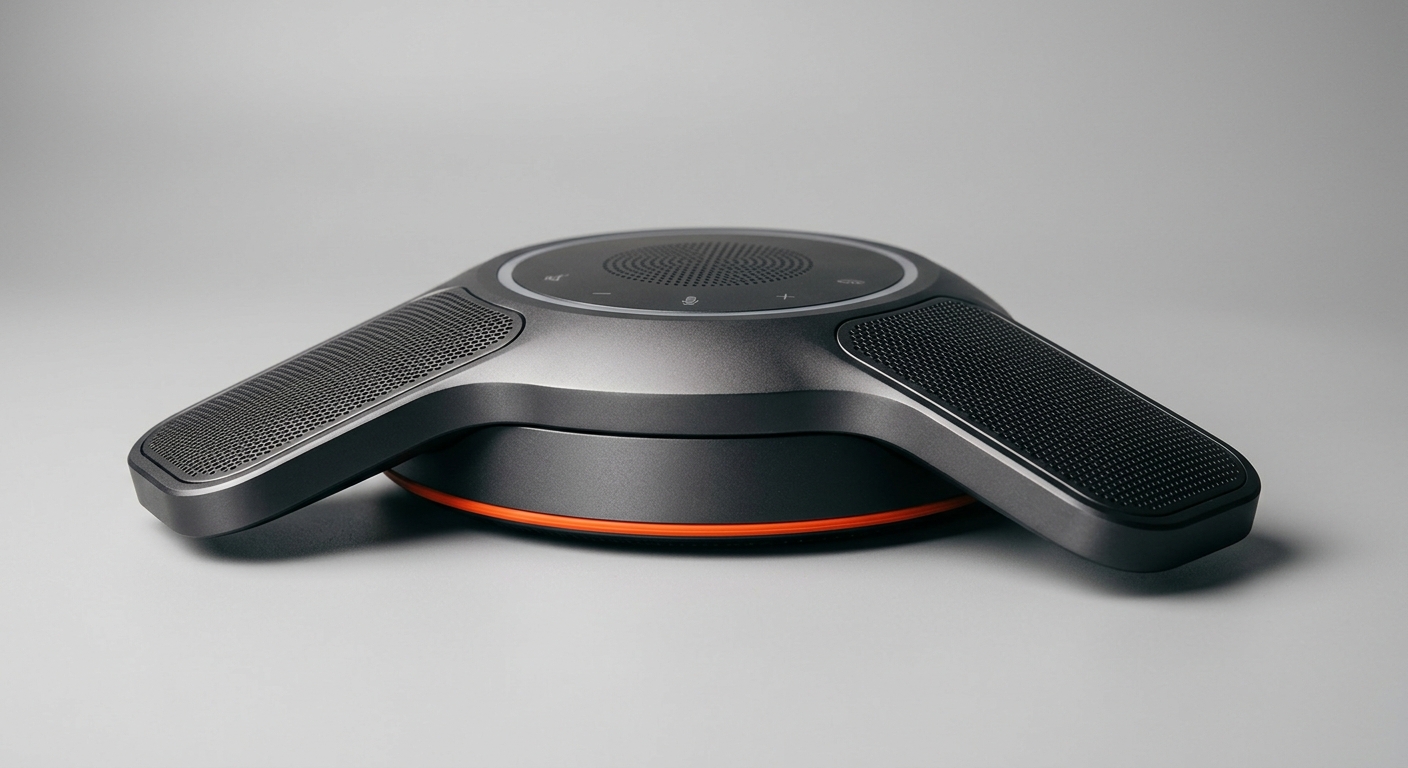
Definition: Meeting Assistant (AI)
An AI meeting assistant is software that joins a call, transcribes it, and produces a structured summary with decisions and action items, no human note-taker required.
Core characteristics of AI meeting assistants
Most tools run as a bot that dials into a meeting or plugs into the video platform, pairing speech recognition with a language model.
- Real-time transcription of spoken audio
- Automatic speaker identification (diarization)
- Summarization of decisions and open points
- Extraction of action items with owners and due dates
Meeting Assistant (AI) vs. transcription software
Transcription software converts audio to text and stops there. An AI meeting assistant condenses that text into a summary and pushes action items into a CRM or chatbot.
Importance of AI meeting assistants in enterprise AI
Meetings consume a large share of knowledge-work time, much spent re-explaining context a good record would preserve. Per Bitkom’s 2026 AI survey, 41 percent of German companies with 20+ employees actively use AI, up from 17 percent a year earlier, with time savings the most cited benefit.
Methods and procedures for Meeting Assistant (AI)
Deploying one needs a defined path from audio to action.
Bot-based capture
The assistant joins as a participant or connects through the platform’s recording API, determining what is captured.
- Calendar integration to auto-join scheduled meetings
- Visible bot presence or in-meeting recording notice
- Raw audio storage governed by a retention policy
Transcription and summarization
Speech-to-text produces a timestamped transcript, then a language model condenses it. Accuracy depends on audio clarity, so quality varies in noisy hybrid rooms.
Action item extraction and write-back
The assistant identifies commitments and writes them into the tools where work happens, closing the loop with workflow automation. CRM automation integration is common, since sales calls generate follow-ups belonging in the deal record.
Important KPIs for Meeting Assistant (AI)
Measuring a program requires metrics beyond whether it produced a transcript.
Operational efficiency metrics
- Time saved per meeting on note-taking: 15-30 minutes
- Action item completion rate after write-back: 20-40% higher
- Meeting-to-summary turnaround: under 5 minutes
- Adoption rate among target meeting types: above 70%
Strategic business metrics
The strategic value lies in fewer status meetings, since information becomes searchable rather than trapped in someone’s memory. Over 60 percent of organizations globally already deploy one, per Grand View Research.
Quality and accuracy metrics
Transcript accuracy for clear audio typically exceeds 90 percent, but action item extraction still needs a human check for ambiguous phrasing like “let’s look into that.”
Risk factors and controls for Meeting Assistant (AI)
Meeting assistants touch sensitive data: what people said in a room.
Data protection and recording consent
Recording employees or external participants triggers GDPR obligations around purpose limitation and transparency.
- Clear notice that a bot is recording
- A defined retention period with automatic deletion
- Restricted access to raw recordings versus the summary
Works council co-determination
In Germany, tools capable of monitoring employee behavior fall under works council co-determination (Section 87(1) No. 6 BetrVG). A works agreement plus Article 88(2) GDPR and Section 26 BDSG is the standard legal basis.
AI hallucination in summaries
Language models can invent details or misattribute a statement, a failure mode covered under AI hallucination. A human-in-the-loop review before summaries reach a client record limits this risk.
Practical example
A 130-employee wholesale distributor in North Rhine-Westphalia ran daily sales calls costing hours of follow-up writing weekly. After a works agreement and a CRM-connected assistant, reps stopped writing call notes by hand.
- Automatic call summaries attached to the CRM opportunity
- Action items routed to the responsible team member with a due date
- Searchable meeting archive replacing scattered personal notes
- Weekly digest of open commitments across all sales calls
Current developments and effects
The category is moving from note-takers toward broader agentic systems.
Multimodal and agentic meeting agents
Newer assistants analyze shared screens and slides, and Gartner forecasts task-specific agents embedded in 40% of enterprise apps by late 2026.
- Screen and document context added to the transcript
- Cross-meeting memory recalling prior discussions on a topic
- Direct handoff of action items to autonomous agents
Transparency obligations under the EU AI Act
Since meeting assistants process conversational data, disclosure duties under the EU AI Act increasingly require labeling that an AI system is transcribing.
Consolidation into unified communications platforms
Video platforms are building native meeting-assistant features, reducing the need for a third-party tool.
Conclusion
AI meeting assistants turn lost meeting time into a searchable, actionable record. For Mittelstand companies, the technology is mature, but rollout runs through the works council before it runs through IT. Getting that sequence right avoids stalled projects. As these tools connect deeper into CRM, the value shifts from better notes to fewer meetings needed at all.
Frequently Asked Questions
What does an AI meeting assistant actually do?
It joins a call, transcribes it, summarizes decisions, and extracts action items, often writing them directly into a CRM or task system.
Is an AI meeting assistant allowed under GDPR?
Yes, with a clear legal basis, transparent notice, and a defined retention period, plus a works agreement in most German companies.
Does a 50-employee company need a works council agreement for this?
Only with an active works council; smaller firms still need a GDPR basis, not a formal agreement.
What does an AI meeting assistant cost for a mid-sized company?
Per-seat pricing runs about 10-30 euros per user monthly; CRM-connected deployments add integration cost.
How long does rollout take?
A basic deployment can go live within days; the works council agreement and CRM integration typically add four to eight weeks.
Can the summaries be trusted without checking the recording?
Not blindly. Summarization can misattribute a statement, so a quick human review before action items reach a client record is good practice.