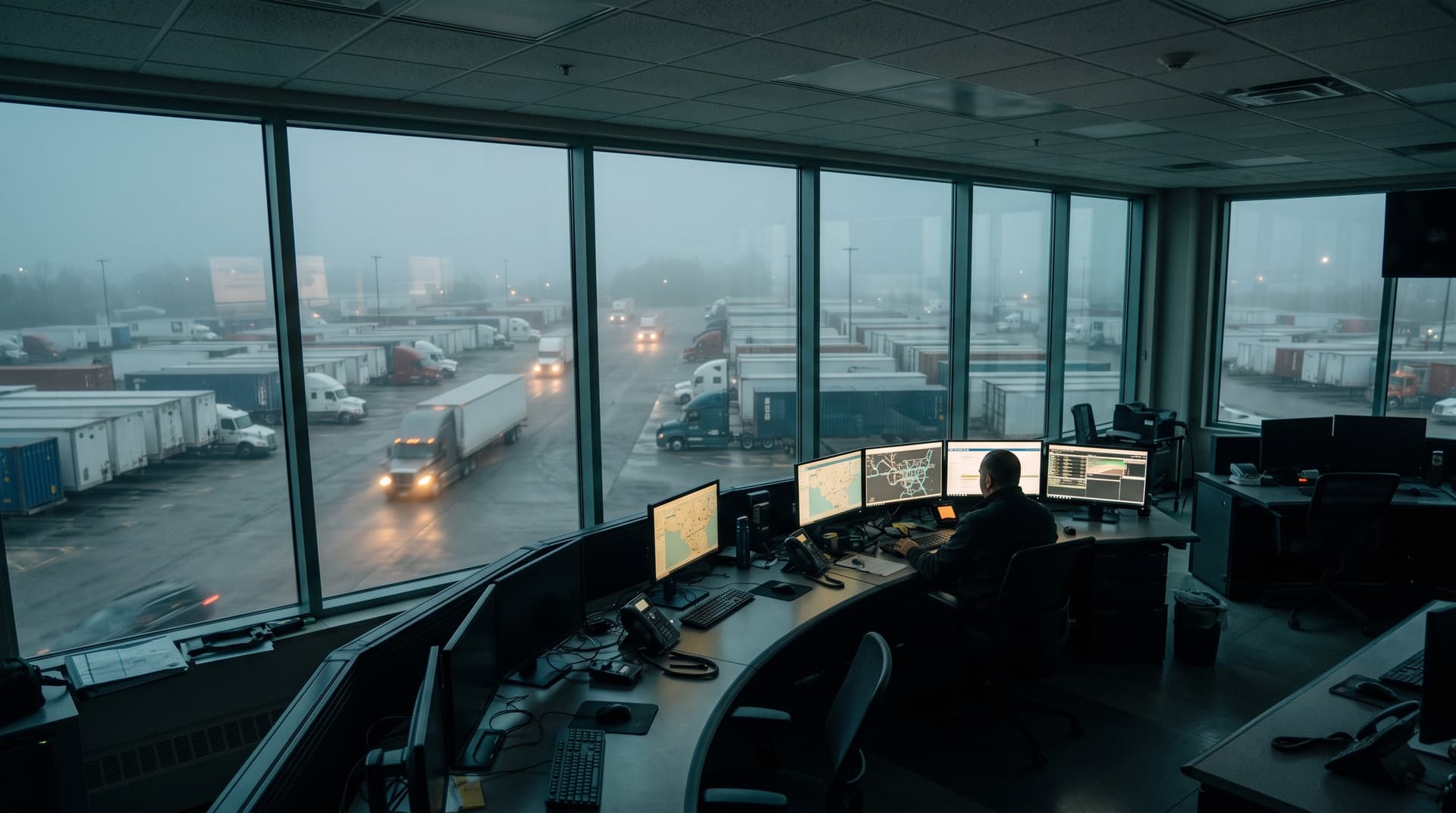
Hire your AI dispatcher.
Plans tours and jobs, spots delays before the customer does, and keeps drivers, technicians, and customers informed. Around 70% of status requests and delay notices are handled without your dispatcher, right inside your TMS, telematics, Outlook, and Teams. First workflows run productively after 2 weeks, and your dispatch team keeps the final say.
Talk to an expertWhat does your AI dispatcher get done in a normal working day?
Morning check before the yard wakes up
Reviews every tour planned for today against vehicle availability, driver check-ins, and overnight messages, and flags what will not work.
Order intake and tour building
Reads new orders from Outlook, customer portals, and the ERP, checks addresses and time windows, and slots them into tours that respect your rules.
Delay detection
Watches telematics, traffic, and loading times, spots tours that will miss their window, and calculates the knock-on effects.
Re-planning and customer notice
Proposes a new sequence for affected stops and drafts the customer notifications before anyone has to call in and ask.
Driver and technician communication
Answers routine driver questions, forwards address corrections and gate codes, and escalates anything unusual to the dispatcher.
Proof of delivery and daily summary
Chases missing delivery notes and signatures, files what arrived, and posts a short summary of the day and tomorrow’s risks.
The routine runs continuously, your dispatcher decides the exceptions.
Your AI employee keeps every tour current, from order to proof of delivery
- Orders planned into tours the day they arrive
- Delays spotted and re-planned before the customer calls
- Your dispatcher decides the hard cases instead of typing messages
What changes in a dispatch week with an AI employee?
Today
- Orders sit in a shared inbox until someone types them into the TMS
- Delays surface when the customer calls to ask where the truck is
- Every re-plan starts from a blank screen while three phones ring
- Drivers call the office for gate codes, addresses, and ramp numbers
- Missing delivery notes turn up weeks later, during invoicing
With your AI dispatcher
- Every order is checked and slotted into a tour on arrival
- Delays are detected from telematics and traffic, not from complaints
- A ready re-plan proposal is waiting when a vehicle or driver drops out
- Routine driver questions are answered without touching the office phone
- Proof of delivery is chased the same day, so invoicing runs clean
Your AI dispatcher is built with your company knowledge: your customers and their time windows, your fleet and vehicle types, your regions and tour patterns, your escalation rules. It plans the way your dispatch actually plans, not the way a generic routing tool assumes.
- Knows your priority customers and their hard delivery windows
- Respects driving hours, vehicle types, and loading restrictions
- Learns your tour patterns from how you have planned before
- Escalates by your rules: cost thresholds, key accounts, hazardous goods

Every dispatch team works differently. What could your AI dispatcher take over from day one?
Order Intake
Reads orders from Outlook, PDF, customer portals, and the ERP and turns them into clean, plannable jobs.
Tour Building
Slots jobs into tours along your rules: time windows, vehicle types, regions, and driving hours.
Address Checks
Validates delivery addresses, ramp details, and access notes before a driver stands in front of a closed gate.
Delay Detection
Watches telematics, traffic, and loading times and raises a flag before the window is missed.
Re-planning
Proposes a new sequence when a vehicle, driver, or customer falls out, with the trade-offs shown.
Customer Notifications
Informs customers about arrival times and delays proactively instead of after the complaint call.
Driver Communication
Answers routine driver and technician questions and forwards only what genuinely needs a dispatcher.
Subcontractor Requests
Prepares charter and subcontractor requests with all details when your own fleet is full.
Proof of Delivery
Chases missing delivery notes, signatures, and service reports until every job is documented.
Freight Documents
Keeps consignment notes, hazardous-goods papers, and service records complete and findable.
Shift Handover
Writes the handover for the next shift: open jobs, known risks, and who promised what to whom.
Daily Debrief
Reports what ran on time, what did not, and which routes cost you money week after week.
And many more. We build AI employees for whatever your dispatch team needs.
Frequently asked questions
Everything you need to know about your AI dispatcher.
It handles the operative dispatch routine: turning incoming orders into planned tours and jobs, watching telematics and traffic for delays, re-planning affected stops, informing drivers and technicians, keeping customers up to date, and chasing missing delivery notes. Anything that needs judgment goes to your dispatcher for a decision: a cancelled tour, an expensive detour, an angry key account.
Yes. Superkind sits on top of your existing stack as one integration layer: your transport management system, telematics and tracking, SAP or another ERP, Outlook, phone, and Microsoft Teams. The AI dispatcher works inside the systems your team already uses. There is no new planning tool to roll out and no data migration.
That is exactly where it earns its keep. When a vehicle breaks down or a driver calls in sick, it immediately shows which tours and stops are affected. It proposes a re-plan within your rules, meaning vehicle types, driving hours, time windows, and priority customers, and drafts the messages to drivers and customers. Your dispatcher approves or adjusts instead of starting from a blank screen while three phones ring.
Your team does. The AI employee prepares tours, re-plans, and messages, and routes everything above your defined thresholds to a human. You decide what it may send on its own, a delay notice to a customer for example, and what always needs approval, such as booking a subcontractor. Every step is logged and stays auditable afterwards.
First workflows typically go live within 2 weeks. We start with the highest-volume routine, usually order intake and proactive customer notifications, then expand into re-planning and proof-of-delivery chasing once the basics run reliably. You do not need a project team: access to the TMS and the shared inbox, your planning rules, and one contact in dispatch are enough.
A fraction of a full-time position, priced per use case. For comparison: a dispatcher role costs roughly 45,000 to 65,000 € a year in fully loaded cost, and TMS and telematics licences usually add 15 to 40 € per vehicle per month. The AI dispatcher scales with tour volume instead of headcount, so you only expand what pays off: empty kilometres avoided, calls not taken, delay notices on time.